
Dunwoody People Directory Landscape
Dunwoody people directories are split among city, county, state, school, university, and library keepers. Start with the directory that records the person's role. A city employee belongs in the municipal staff list. A parcel owner appears in DeKalb tax or appraisal data. A regulated professional may appear in a Georgia licensing database. A past resident may be easier to locate in a regional city directory than in a modern web index.
| Directory source | People or roles listed | Keeper | How to use it |
|---|---|---|---|
| Dunwoody staff directory | City employees and officials | City of Dunwoody | Free A-Z browse and department filter |
| School and university directories | District staff and regional faculty | DCSD and Emory | Public institutional lookup, subject to privacy limits |
| DeKalb property roll | Owners and tax mailing contacts | DeKalb County | Free owner, address, or parcel search |
| Georgia filing directories | Licensees, entities, agents, and filing officers | Georgia Secretary of State and boards | Free basic verification and entity summaries |
| City directories | Past residents, businesses, and occupations | DeKalb County Public Library | Print and microfilm at Decatur Library |
| Cemetery and vital indexes | Decedents, spouses, and family links | Library, archives, and record custodians | Index or finding aid, followed by record verification |
These are role directories, not one master resident list. Their dates and meanings differ. A staff roster proves an official work role when listed. A deed index records a party to an instrument. A tax roll identifies a listed owner or mailing contact, which may not be the person living at the property.
Dunwoody Government Directory Search
The City of Dunwoody staff directory is the strongest official name directory within city government. It can be browsed across all entries, by surname initial, or by department. Sort and page controls help with broad browsing. Entries use surname-first display and connect a name to a current public role rather than to a home address.
| Directory control | Input type | How it narrows Dunwoody staff |
|---|---|---|
| All, #, or A-Z | Browse tabs | Selects a surname initial or all entries |
| Department | Dropdown | Limits results to a city department |
| Sort | Order control | Changes name or title order |
| Page | Pagination | Moves through additional results |
A typical entry separates the person's public role from private contact data. The visible field set is concise:
| Staff name | Displayed in surname, given-name order |
|---|---|
| Title | Current city role |
| Department | City unit tied to the role |
| Work phone | Direct public number when listed |
| Link that may use a protected contact form |
Home and other private contact fields do not appear. If a name is absent, call the department main line or City Hall, then use the city records channel only when an actual public record is needed.
DeKalb County publishes departments and contacts, but the research found no complete county employee-name phone book. Georgia takes a similar office-first approach. Its state organization directory routes readers to agencies rather than offering one consolidated employee list.
The official Georgia state-organizations directory illustrates that office-based structure:
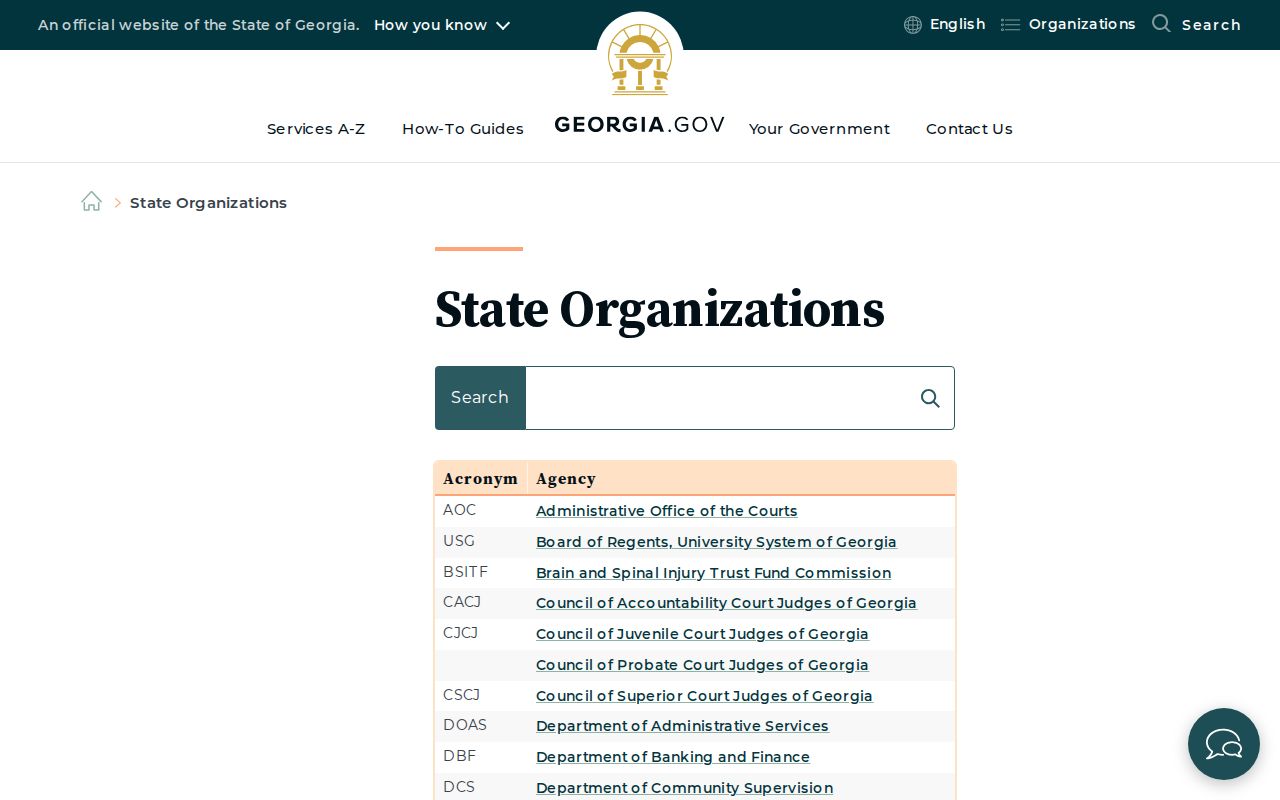
Use the agency page to locate a division or main contact, then confirm whether that agency maintains its own public staff roster.
Dunwoody School Directory Routes
Dunwoody public schools are part of DeKalb County School District. The district and individual school pages are the right directory route for a teacher, administrator, or program contact. Search by staff member or school where the current interface permits, then confirm the role on that school's official staff page. A directory result reflects an institutional role and should not be treated as a resident listing.
The Emory University directory can help with a regional faculty or staff connection. Emory lies outside Dunwoody city limits, though. Its entries establish an Emory role, not Dunwoody residence. No university campus within Dunwoody proper was identified for a city-specific faculty directory.
Older education trails work differently. School yearbooks can reveal a name variant, class year, portrait, club, or activity. Alumni and school-community directories may be private or member-controlled, so their lack of open web access should be respected. Verify a yearbook match with the school, graduation year, and middle initial because captions can contain mistakes.
Note: A regional university result needs a second Dunwoody-specific fact before it can support a local connection.
Dunwoody Property Owner Directories
The DeKalb property-tax search works as a name directory for listed owners. It accepts an owner name, street address, or parcel identifier. Results may show a current owner, tax mailing address, tax district, parcel history, and bills. The appraisal side adds property characteristics, value components, sales, and other parcel detail.
A situs address is the physical site. A mailing address is where tax notices go. They may differ, and neither proves who lives at the property now. Entity ownership, a post office box, or a dated mailing address can make the apparent people link misleading.
DeKalb GIS adds parcel boundaries, municipal limits, zoning, and mapped context. It does not issue deeds, plats, or surveys. A reader who finds a book and page should take those references to the DeKalb Superior Court Clerk. The full access and request rules belong with Dunwoody public records, while the property directory itself is best used to connect a name, parcel, and date.
Dunwoody Deed Party Directories
The GSCCCA Real Estate index turns recorded deeds, security deeds, liens, assignments, cancellations, and plats into a party-name directory. Select DeKalb County for Dunwoody land, then search grantor, grantee, or both. A grantor generally transfers or encumbers an interest. A grantee receives an interest. Search both roles because one name can appear on different sides over time.
The statewide index generally reaches back to 1993, but exact DeKalb image coverage must be confirmed with the clerk. Results commonly include party names, instrument type, filing date, book, page, and instrument number. Those identifiers allow a precise follow-up even when a common name produces many hits.
Older books may require the clerk counter, Georgia Archives microfilm, or another repository channel. Try surname-first forms, initials, married or hyphenated names, and entity or trust names. An index entry proves a recorded role. It does not by itself establish current title, current address, or family relationship.
Dunwoody Professional License Directories
The Georgia professional-license verification searches many regulated occupations by profession, license type, license number, first name, last name, city, and state. A license number is the strongest key when available. Capture the profession, credential number, status, issue and expiration dates, and any linked discipline or order, then compare the city and full name with the intended person.
No single portal covers every field. Lawyers use the State Bar of Georgia directory. Physicians may be under the Georgia Composite Medical Board. Nurses, educators, real-estate licensees, and contractors have their own board or commission routes. The city can also hold occupational-tax, alcohol-license, and permit records that name an applicant or business contact.
- Use the board tied to the profession.
- Prefer a license number over a broad name match.
- Read status dates before treating an entry as current.
- Do not assume a work city is a home city.
Dunwoody's Perimeter business district creates many work-address matches. A suite address may hold unrelated practices and registered-agent offices. Treat each as a dated professional link, not proof that the person resides in Dunwoody.
Dunwoody Business Filing Directories
The Georgia corporation search connects business entities with agents and filing roles. Search by business name, control number, registered-agent name, or officer name where the interface exposes that mode. Name matching can use exact, starts-with, or contains logic. Status and business-type filters help separate similar entities.
An entity detail can show legal name, control number, type, status, formation date, principal office, registered agent, and annual-registration history. A registered agent accepts legal process and need not own or operate the company. Likewise, an active status means that the entity is compliant with state filing rules, not that a Dunwoody storefront is open.
Trade names are generally filed through the county Superior Court clerk, while local occupational-tax records come from Dunwoody. The Dunwoody Perimeter Chamber may list member businesses and public-facing contacts. Compare dated state filings with city permits or licenses when the identity of a business contact matters.
Historical Dunwoody People Directories
The best documented historical directory collection is not at the neighborhood branch. The Decatur Library local-history collection, at its second-floor Reference Desk, holds city directories in print and microfilm dating to 1928. The books cover a broader Atlanta and DeKalb market, so each volume must be checked for Dunwoody coverage.
The library's collection page shows the range of local-history material available for a Dunwoody directory search:
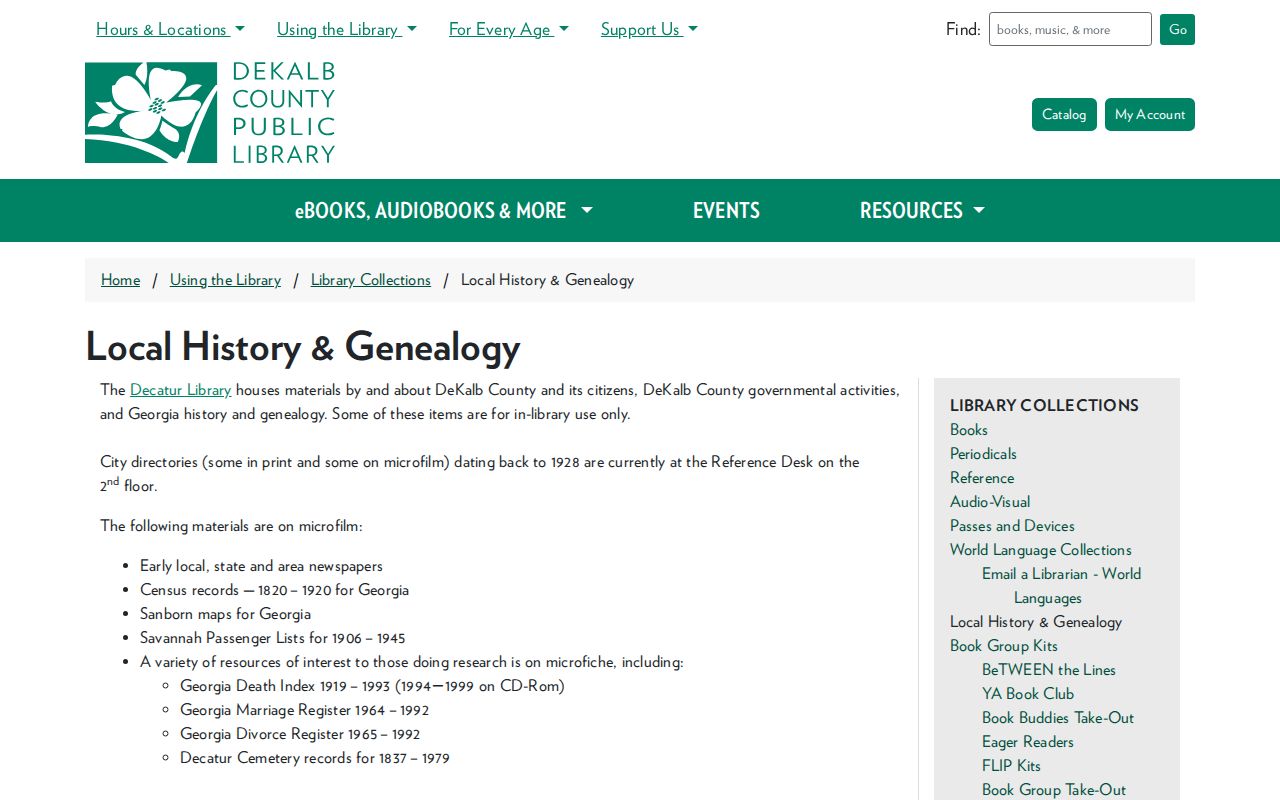
Ask the Reference Desk about exact volume gaps and reverse sections. Some works are for in-library use, and the official page does not list every publisher or year.
- City directory
- A dated list of residents and businesses, often with an occupation or spouse.
- Reverse directory
- A section arranged by street address, useful for finding the listed occupant of an old address.
- Finding aid
- A repository description that points to a collection, box, film, or volume rather than giving the final fact.
- Microfilm
- A photographed record run read on library equipment, sometimes with no web copy.
Dunwoody Directory Years and Names
Historical Dunwoody residents may be filed under Atlanta, Chamblee, Doraville, or a rural route. Dunwoody existed as a community long before it incorporated in 2008, and the modern city name does not control every older index. That is the central directory quirk for local family research.
- Before 1822: Search predecessor-county and state land sources.
- 1822 to 1900: Use DeKalb deeds, probate and marriage books, tax digests, church registers, cemeteries, and newspapers.
- 1900 to 1950: Add census schedules, draft cards, schools, and regional directories.
- 1950 to 2008: Reverse directories, plats, yearbooks, tax rolls, and phone books become more useful.
- Since 2008: City staff, minutes, permits, and police records sit alongside county directories.
Start near a known year. Check the name section and spouse notation, then use the reverse-address section if one exists. Trace adjacent years to spot arrival or departure. Pair the result with a deed or tax roll. The 1890 federal census loss makes directories, tax digests, deeds, and newspapers vital substitutes for that decade.
Note: A directory year dates the listing; it does not prove that the information stayed true for the whole year.
Dunwoody Genealogy Directory Finds
DeKalb's digitized Marriage Book F covers 1887 through 1893 and is indexed in the Georgia Archives Virtual Vault. It supplies a concrete name directory for an era when Dunwoody was a community within DeKalb rather than an incorporated city. Browse the index, inspect the record image, and retain the book reference for citation.
Decatur Library also documents the Georgia Death Index for 1919 through 1999 across microfiche and CD formats, the Georgia Marriage Register for 1964 through 1992, the Georgia Divorce Register for 1965 through 1992, and Decatur Cemetery records for 1837 through 1979. These tools can connect spouses, event years, and burial evidence.
Church registers, cemetery records, funeral-home obituaries, and newspapers can add relationships, prior residences, schools, congregations, and burial sites. Access may be controlled by the repository or congregation. A memorial transcription or obituary is a lead, so confirm key claims with a vital, probate, deed, or court record.
Dunwoody Directory Privacy Boundaries
No official municipal white-pages database lists Dunwoody residents. The Georgia My Voter Page is an authenticated self-service tool, not a public browse-by-name directory. Neighborhood, homeowners' association, congregation, alumni, and membership directories are usually private or member-controlled. They should not be solicited, copied, or republished without permission.
Public board rosters, council minutes, and chamber member listings are different because they record an official or public-facing role. Even then, context matters. A name in minutes may identify a speaker or applicant on one date. A newsletter roster may prove membership at a time, not permanent residence.
Commercial compilation databases can lag behind corrections and merge people with similar names. Official directory keepers provide the better confirmation path. When an entry is wrong, seek correction from the office, school, board, archive, or other source that maintains it.